Every phone spec sheet lists a RAM number — 8GB, 12GB, sometimes even 16GB — but what is RAM actually doing, and is more always better? This guide explains what RAM is, how it’s different from your phone’s storage, what DDR and LPDDR generations actually mean, and how much RAM genuinely makes sense to pay for in 2026.
Quick answer: RAM is your device’s short-term, high-speed workspace — it temporarily holds the apps and data your processor is actively using, unlike storage, which holds information permanently. For most people in 2026, 8GB is the practical sweet spot; 12GB is worth it for heavy multitasking or gaming.
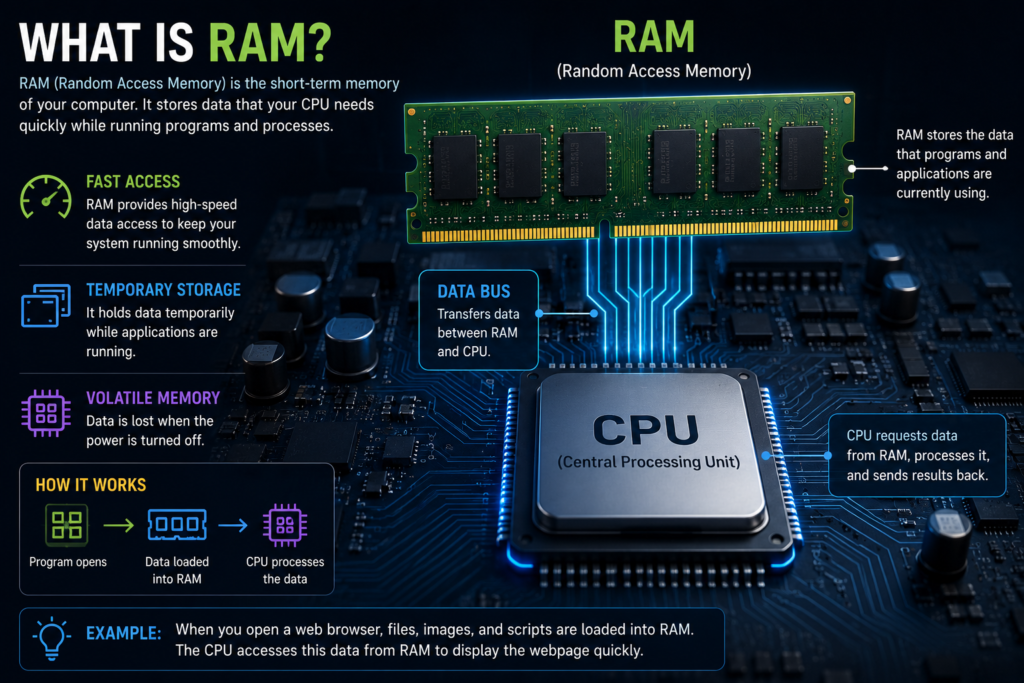
What Is RAM, Really?
RAM (Random Access Memory) is volatile memory — meaning whatever it’s holding disappears once power is cut, unlike your phone’s internal storage, which keeps data permanently. RAM is also dramatically faster than storage. When you open any app, it doesn’t go straight to the processor — it loads into RAM first, and RAM then feeds that data to the processor at very high speed.
Here’s a simple real-world comparison: imagine an office worker who needs several files to do his job. Instead of walking to the file room every single time, he keeps the files he needs close by on his desk, grabbing whichever one he needs as he works. RAM works the same way — it keeps your active apps close to the processor, ready to be used instantly, which is exactly why you can switch between apps without losing your place.
RAM vs Storage — What’s the Actual Difference?
- Storage (like your phone’s internal 128GB/256GB) holds data permanently — photos, apps, files — even after a restart.
- RAM holds only what’s actively in use right now — if you restart your phone, everything that was in RAM clears out, and apps have to reload from storage.
- RAM is significantly faster than storage, which is exactly why it’s used as the processor’s short-term workspace instead of pulling everything from storage directly.
What Does DDR (or LPDDR) Actually Mean?
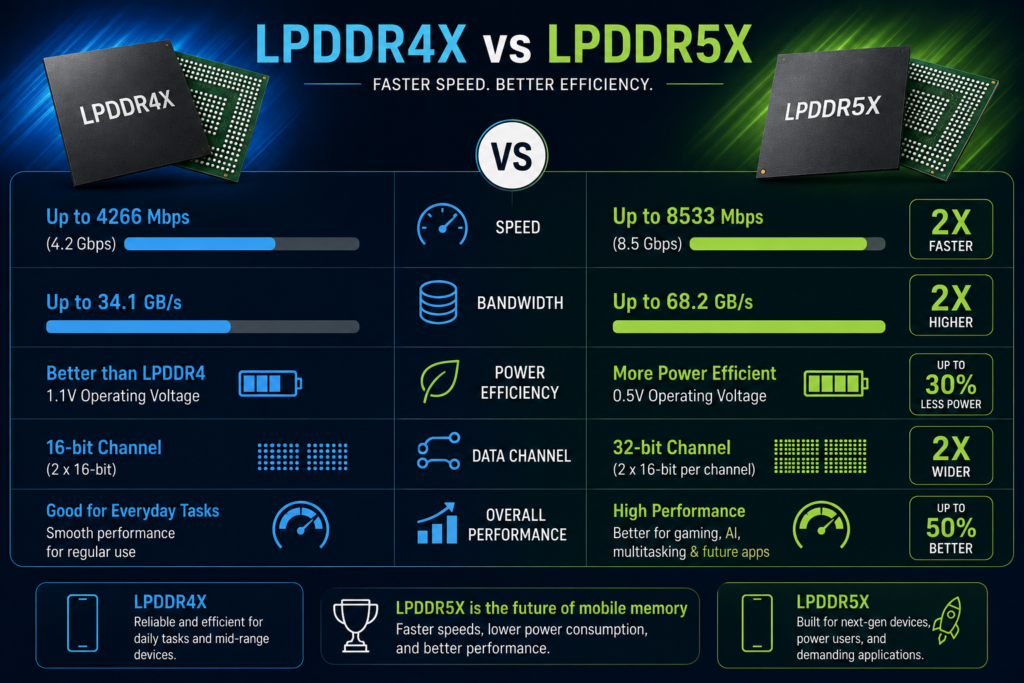
DDR refers to RAM’s clock speed — similar to how a processor has a clock speed measured in GHz. Each new DDR generation (DDR2, DDR3, DDR4, and so on) runs at a higher speed than the one before it. One important clarification for smartphones specifically: phones use a mobile-optimized version called LPDDR (Low Power DDR) — not the same DDR chips used in desktop PCs. You’ll see generations like LPDDR4X, LPDDR5, and LPDDR5X, each faster and more power-efficient than the last.
How Much RAM Do You Actually Need in 2026?
RAM requirements have grown significantly since 2019, when 4GB was considered a solid baseline. Here’s where things stand now:
| RAM Amount | Good For | 2026 Notes |
| 4-6GB | Basic calls, messaging, light browsing | Entry-level only; increasingly limiting |
| 8GB | The practical sweet spot for most users | Smooth daily multitasking on most phones |
| 12GB | Heavy multitaskers, gaming, content creators | Standard on many 2026 flagships |
| 16GB+ | On-device AI, high-end gaming, power users | Growing on premium flagships; marginal gain for average use |
For most people, 8GB remains the genuine sweet spot — smooth daily multitasking without paying extra for capacity you won’t use. 12GB is worth it specifically for heavy multitaskers, gamers, or anyone keeping 20+ apps alive across sessions. 16GB+ is increasingly common on premium flagships, largely to support on-device AI features, but the real-world difference for typical daily use (social media, messaging, browsing) is minimal.
A 2026 Buying Note: RAM Prices Are Up
Worth knowing if you’re shopping for a new phone right now: mobile RAM and storage prices rose sharply in early 2026, driven largely by AI chip demand pulling memory production away from consumer devices. This means reaching higher RAM tiers (like 16GB) sometimes now requires buying a more expensive storage bundle too, even if you don’t need the extra storage. It’s worth checking exact configurations rather than assuming RAM scales independently of price.
Quick Recap
- RAM = volatile, high-speed memory that temporarily holds your active apps — unlike storage, it clears when the device restarts.
- DDR/LPDDR = RAM’s clock speed generation — LPDDR5X is the current standard for 2026 flagships, offering higher bandwidth and better power efficiency than older LPDDR4X.
- 8GB is the practical sweet spot for most users in 2026; 12GB suits heavy multitaskers and gamers; 16GB+ mainly benefits on-device AI and power-user workflows.
FAQs — Frequently Asked Questions
Q1. What is RAM in simple terms?
RAM is your device’s short-term, high-speed memory. It temporarily holds the apps and data your processor is actively using, unlike storage, which holds data permanently even after a restart.
Q2. What happens to RAM when I restart my phone?
Everything stored in RAM clears out immediately, since RAM is volatile memory. Any apps that were open will need to reload from storage the next time you open them.
Q3. What does DDR mean in RAM?
DDR refers to RAM’s clock speed generation — each new version (DDR2, DDR3, DDR4, etc.) runs faster than the last. Smartphones use a power-efficient version called LPDDR, with LPDDR5X being the current standard in 2026 flagships.
Q4. How much RAM do I actually need in a smartphone in 2026?
8GB is the practical sweet spot for most users, handling daily multitasking smoothly. 12GB suits heavy multitaskers or gamers, while 16GB+ mainly benefits on-device AI features and power users.
Q5. Is more RAM always better?
Not necessarily for the average user — most people won’t notice a real-world difference between 12GB and 16GB in daily tasks like messaging or browsing. Games and AI-heavy workloads are where higher RAM actually shows a benefit.
Q6. What is LPDDR5X?
It’s the current generation of mobile RAM used in most 2026 flagship phones — faster and more power-efficient than the older LPDDR4X standard, with notably higher bandwidth for AI processing and camera pipelines.
Q7. Why do phone RAM prices seem higher in 2026?
A global memory shortage, driven largely by AI chip demand pulling production capacity away from consumer devices, pushed RAM and storage prices up significantly in early 2026 — expect this to ease as new production capacity comes online.
Q8. Is RAM the same as storage?
No. Storage holds your files, photos, and apps permanently. RAM temporarily holds only what’s actively in use right now, and clears out when the device restarts — it’s a workspace, not a filing cabinet.
Final Thoughts — Buy Based on Real Usage, Not Just the Bigger Number
RAM’s core job hasn’t changed since 2019 — it’s still your device’s fast, temporary workspace for whatever you’re actively using. What has changed is the scale: 4GB used to be a reasonable baseline, and now 8GB is the realistic minimum for smooth daily use, with 12GB and 16GB increasingly common at the top end. Buy based on how you actually use your phone — daily browsing and messaging don’t need 16GB, but heavy multitasking or gaming genuinely benefits from it.
If you found this guide helpful, subscribe to the TapsVision YouTube channel and hit the bell icon — we post clear, well-researched tech explainers regularly, in both Hindi and Hinglish, just for you!
Subscribe TapsVision on YouTube for daily Hindi tech tips — RAM, processors, Android, and more!
Have a question? Comment below or message us on the YouTube video. Everyone is welcome in the TapsVision community!
— TapsVision