Every phone, laptop, and computer spec sheet throws around terms like “7nm processor,” “octa-core,” or “3nm chip” — but what do these numbers actually mean, and why should you care? This guide breaks down what a processor does, what nanometer (nm) technology really represents, and why core count affects multitasking — using simple, everyday comparisons, and updated with where the technology actually stands in 2026.
Quick answer: a processor is your device’s “brain” — it handles every task your phone or computer performs. Nanometer (nm) refers to the size of the transistors packed inside it (smaller = more efficient and powerful), and core count refers to how many processing units are working together to handle multiple tasks at once.
Why the Processor Is the Most Important Part of Your Device
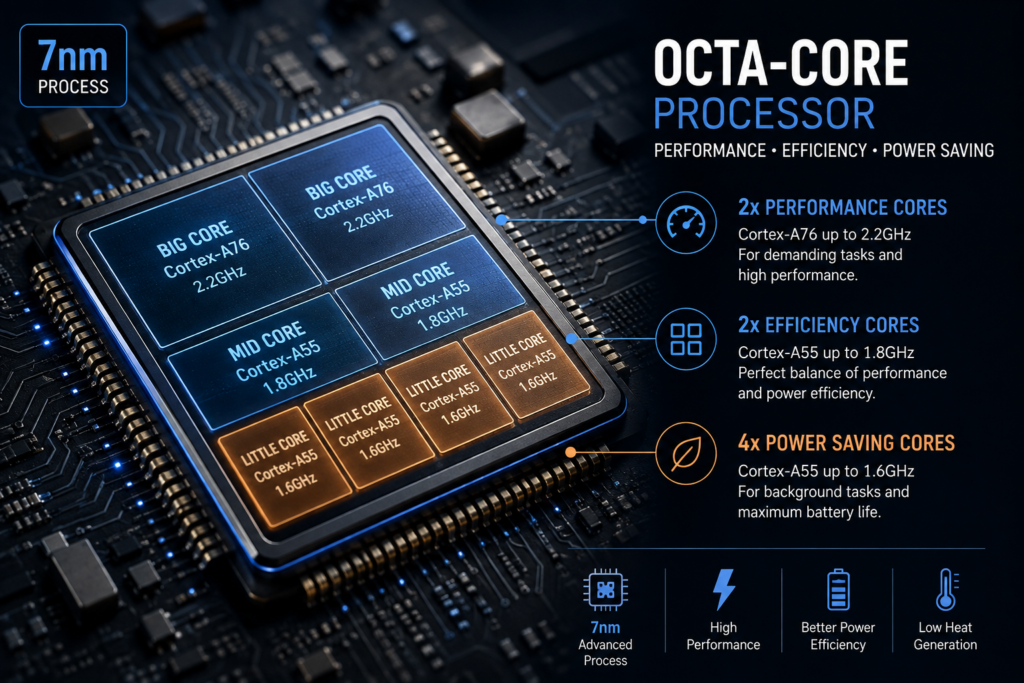
Think of a processor like the engine of a car. Without an engine, a car can’t move — and every function the car performs depends on that engine. Your phone’s processor works the same way: it’s essentially the “brain” that handles everything your device does. It’s genuinely one of the single most important specs on any smartphone, laptop, or computer.
What Do “Octa-Core,” “Hexa-Core,” and Similar Terms Mean?
A processor’s cores are essentially the processor divided into multiple independent processing layers. A quad-core processor is divided into 4 such units; an octa-core is divided into 8. Here’s a simple way to picture why this matters: if one person takes 8 hours to finish a task alone, splitting that same task across 4 people could get it done in about 2 hours. That’s the same logic used inside a processor — splitting work across multiple cores is what makes real multitasking possible, letting you run several apps at once while things keep working smoothly in the background.
What Does “Nanometer” (nm) Actually Mean in a Processor?
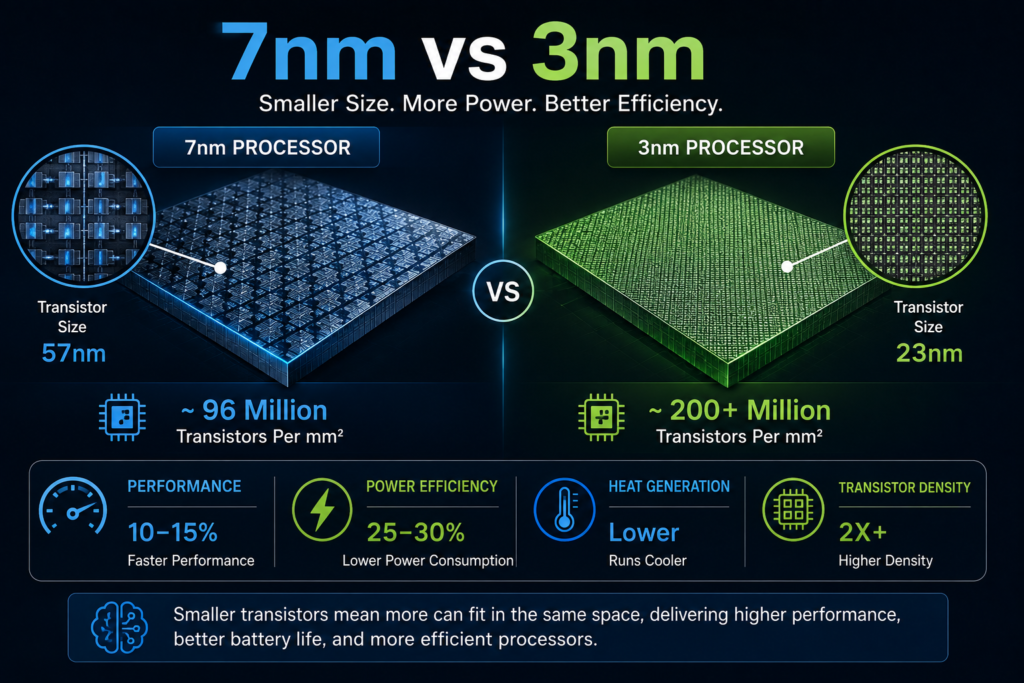
A processor contains millions of tiny transistors. The nanometer number you see in a spec sheet refers to the size of the gap, or “leg,” between these transistors — essentially how small and tightly packed the transistors are. The smaller this number, the more transistors can be packed into the same space, which generally makes the processor both more power-efficient and more powerful. This is exactly why flagship smartphone processors move to a smaller nanometer process almost every year.
How Nanometer Technology Has Evolved — 2019 vs 2026
To put this in perspective, here’s how the typical process node has shifted over the years:
| Process Node | Era / Example Chips | Where You’d See It Today |
| 14nm / 12nm | Snapdragon 636, early Helio chips (~2018-2019) | Very old budget devices only |
| 10nm | Snapdragon 835/845-era chips | Largely phased out |
| 7nm | Apple A12 Bionic, Snapdragon 855+ (~2019-2020) | Entry-to-mid-range devices today |
| 5nm / 4nm | Snapdragon 8 Gen 1/2/3, Dimensity 9000-series | Common in current mid-range and older flagships |
| 3nm | Apple A19 Pro, Snapdragon 8 Elite-series, Dimensity 9500 | 2026 flagship standard |
In 2019, 7nm was considered cutting-edge (found in chips like the Apple A12 Bionic and Snapdragon 855+). By 2026, the flagship standard has moved to 3nm, seen in chips like Apple’s A19 Pro, Qualcomm’s latest Snapdragon 8 Elite-series, and MediaTek’s Dimensity 9500. The core concept hasn’t changed — smaller nanometer numbers still mean better efficiency and performance — but the numbers themselves keep shrinking as manufacturing technology improves.
Does a Smaller Nanometer Number Always Mean “Better”?
Generally yes, but with one honest caveat worth knowing: different manufacturers (TSMC, Samsung, Intel) don’t measure their “nm” figures using perfectly identical methods, so a “4nm” chip from one foundry isn’t always exactly comparable to a “4nm” chip from another. Real-world benchmarks, battery efficiency, and sustained performance under heat matter just as much as the nanometer number alone — so it’s a useful indicator, not the entire picture.
Quick Recap
- Processor = the “brain” of your device, handling every task it performs.
- Cores = how many independent processing units your processor is divided into — more cores generally means better multitasking.
- Nanometer (nm) = the size of the transistor gaps inside the processor — smaller numbers mean more transistors packed in, which usually means better efficiency and performance.
- The specific “best” nanometer figure changes yearly — what was flagship-level in 2019 (7nm) is now considered a mid-range or older spec in 2026 (3nm is the current standard).
FAQs — Frequently Asked Questions
Q1. What does 7nm mean in a processor?
It refers to the manufacturing process size — roughly the scale of the transistor structures inside the chip. A 7nm processor packs transistors more tightly than an older 10nm or 12nm chip, generally making it more power-efficient and capable.
Q2. Is 7nm still a good processor in 2026?
It’s now considered an older, entry-to-mid-range specification. Flagship phones in 2026 have moved to 3nm processors, which are meaningfully more efficient and powerful than 7nm chips from a few years ago.
Q3. What does octa-core processor mean?
It means the processor is divided into 8 independent processing cores that can work on different tasks simultaneously, which improves multitasking and helps background apps keep running smoothly.
Q4. What is nanometer (nm) technology in a processor?
It refers to the size of the transistor structures packed inside the chip. Smaller nanometer numbers mean more transistors fit into the same space, generally resulting in better performance and power efficiency.
Q5. 7nm vs 10nm — what’s the real difference?
A 7nm processor packs transistors more densely than a 10nm chip, which typically translates to better power efficiency and performance in real-world use, though the exact difference also depends on the specific chip design.
Q6. What is the latest mobile processor technology in 2026?
3nm is the current flagship standard, used in chips like Apple’s A19 Pro, Qualcomm’s newest Snapdragon 8 Elite-series, and MediaTek’s Dimensity 9500. Mid-range phones commonly still use 4nm or 5nm chips.
Q7. Does a smaller nanometer number always mean a faster processor?
Generally, yes, but not always directly comparable across manufacturers — TSMC, Samsung, and Intel measure their “nm” figures somewhat differently, so real-world benchmarks and sustained performance matter alongside the raw nanometer number.
Q8. What is the difference between a processor and a core?
The processor is the overall chip; cores are the individual processing units inside it. A single processor can contain multiple cores (like 8 in an octa-core chip), each capable of handling tasks independently.
Final Thoughts — The Concepts Stay the Same, the Numbers Keep Shrinking
Whether it’s 2019 or 2026, the core ideas behind mobile processors haven’t changed: more cores mean better multitasking, and a smaller nanometer number generally means better efficiency and performance. What does change every year is which specific number counts as “flagship” — 7nm was cutting-edge in 2019, and 3nm holds that spot in 2026. Understanding the underlying concept means you’ll be able to make sense of whatever number comes next.
If you found this guide helpful, subscribe to the TapsVision YouTube channel and hit the bell icon — we post clear, well-researched tech explainers regularly, in both Hindi and Hinglish, just for you!
Subscribe TapsVision on YouTube for daily Hindi tech tips — processors, Android, Windows, and more!
Have a question? Comment below or message us on the YouTube video. Everyone is welcome in the TapsVision community!
— TapsVision